Documented but Not Followed: Why Processes Fail in Practice

Documented processes are not followed when documentation stays disconnected from daily work. Among 50 respondents of the HEFLO Process Maturity Assessment, only 14% say their documented processes are always followed. Process adherence improves when a process is findable, understood, owned and executed through workflow, not when it is documented in more detail.
You have probably seen this happen. The procedure exists and everyone was told about it, yet the work still gets done another way. This article starts where process documentation guides end. It uses original survey data to show where process adherence breaks down and gives you a practical path from documentation to execution.
In this article, you'll learn:
- How often documented processes are actually followed, and why employees deviate
- Why the gap is usually an execution problem, not a documentation problem
- How to diagnose any process with the Process Adherence Ladder, a four-step framework
- How to move a process from documentation to workflow in five steps
- Which BPM software features improve process adherence, and how to measure it
What does "documented but not followed" mean?
"Documented but not followed" describes a process that has an official, written version that employees do not apply consistently in daily work. The gap sits between three versions of the same process:
- The documented process: the version in a procedure, a wiki, a PDF or a BPMN diagram.
- The practiced process: the version people actually perform, shaped by habit, shortcuts and advice from colleagues.
- The executed process: the version that runs inside a system, where a workflow carries the tasks, forms, rules and deadlines.
Take a purchase request, a process almost every company has. The documented process says that requests above a set amount need three quotes and a manager's approval. The practiced process is what a new analyst learns from a colleague: quotes are "only for big purchases," and approval "can be done by email." The executed process exists only when a workflow requires the quotes above the threshold and sends the task to the approver. This article returns to this example in each section.
Process adherence is the degree to which the practiced process matches the documented process. Process compliance is a narrower idea: it usually refers to meeting external requirements, such as regulations or certification standards. A company can pass a document review and still have weak process adherence in the back office.
Process adherence measures whether work follows the standard, not whether the standard exists.
How often are documented processes actually followed?
Not often. Among 50 respondents of the HEFLO Process Maturity Assessment, only 14.0% say their documented processes are "always" followed.
The most common answer is more ambiguous. Among the same respondents, 38.0% say documented processes are followed "sometimes." If you manage processes, "sometimes" is the hardest state to deal with. The process looks valid on paper and the documents exist, yet outcomes vary by person, team and day.
A smaller group reports a clearer problem: 16.0% of these respondents say documented processes are "rarely" followed.
When "sometimes" is the norm, a documented process is a suggestion, not a standard.
Why do employees deviate from documented processes?
Respondents could choose up to three reasons, so the percentages below do not add up to 100%. Among 52 respondents of the HEFLO Process Maturity Assessment, the reasons for deviation rank as follows:
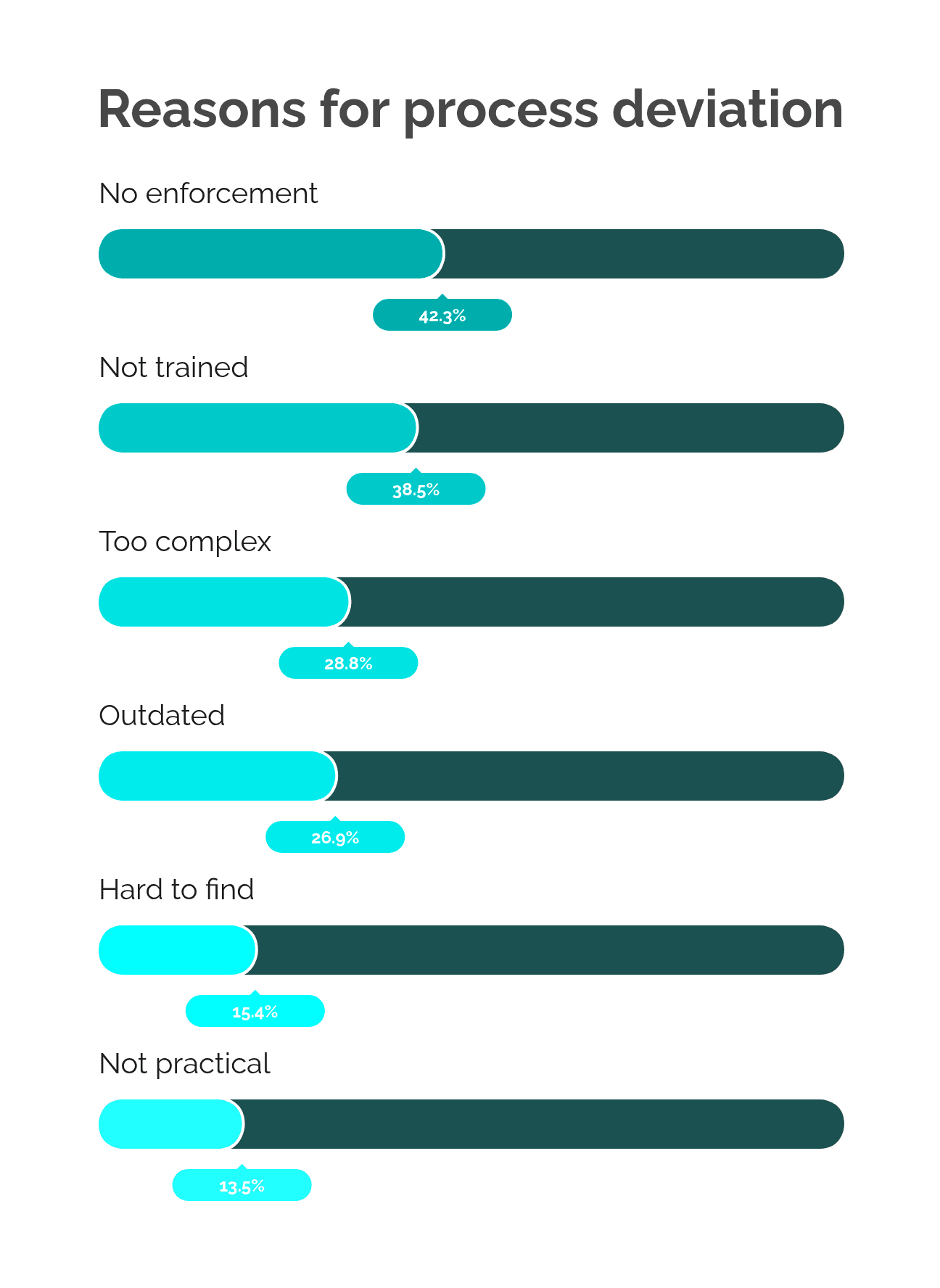
- No enforcement: 42.3%
- Not trained: 38.5%
- Too complex: 28.8%
- Outdated: 26.9%
- Hard to find: 15.4%
- Not practical: 13.5%
Two findings stand out. First, the top two reasons describe how the organization runs the process, not the document itself: nothing checks whether the process is followed, and people were not prepared to follow it. Second, "outdated" ranks fourth. If your first reflex is to rewrite the procedure, you are fixing a real issue, but not the one respondents cite most.
Documentation quality still matters. A process that is too complex or out of date will fail even with strong enforcement. The point is the order of priority, not a choice between documentation and execution.
Employees deviate from documented processes mainly because nothing in daily work requires or teaches the documented way.
Is the problem the documentation or the way work is executed?
The data points to execution. Among 54 respondents of the HEFLO Process Maturity Assessment, only 14.8% say their documented processes are connected to workflow or automation.
Partial connection is the most common situation. Among the same respondents, 46.3% say processes are "partially" connected to execution, and 38.9% say they are not connected at all. In the purchase request example, partial connection means the approval runs in a system while the quotes, the threshold and the follow-up live in a document. That is exactly where deviations accumulate.
The systems people use every day do not close this gap. Among 54 respondents, 48.1% describe the support their systems give to process execution as "limited." Only 11.1% describe it as "strong."
When the system does not carry the process, the employee has to carry it from memory, from a PDF or from a colleague.
How do new employees actually learn processes?
Mostly from other people. Respondents could select up to three channels. Among 44 respondents of the HEFLO Process Maturity Assessment, 63.6% say people learn processes by asking colleagues.
Formal training comes second, cited by 45.5% of these respondents. Process documents rank lower, at 25.0%, the same share as trial and error.
This is tribal knowledge: the real process lives in people's heads and travels by conversation, like the "quotes are only for big purchases" rule in the purchase request example. Tribal knowledge works in small, stable teams. It becomes a risk in these situations:
- A key person leaves, goes on leave or changes role, and the knowledge leaves with them. Panopto's Workplace Knowledge and Productivity Report (July 2018) is an online survey run with YouGov among 1,001 US adults employed by organizations with at least 200 employees. The report found that "42 percent of institutional knowledge is unique to the individual."
- Different colleagues teach different versions of the same process.
- New hires copy workarounds instead of the standard.
- Auditors ask for evidence that the documented process is the one actually performed.
When colleagues are the main channel for learning a process, the organization does not control which version of the process is taught.
Can employees find process documentation when they need it?
Often they do not look. Among 45 respondents of the HEFLO Process Maturity Assessment, 62.3% say process documentation is consulted rarely or never.
Visibility is limited as well. Among 46 respondents, only 15.2% say "everyone" knows where process documentation is stored.
Partial knowledge is the more common situation. Among these 46 respondents, 41.3% say "only some people" know where the documentation is. In practice, those people become informal help desks, which reinforces the tribal knowledge pattern.
Format plays a role. Among 45 respondents, only 13.3% describe their documentation as "interactive and centralized." The largest group, 40.0%, describes it as "structured but static."
Here is a simple test: could a new analyst find your purchasing procedure in under a minute, without asking anyone?
A process nobody can find is a process nobody can follow.
What is the Process Adherence Ladder?
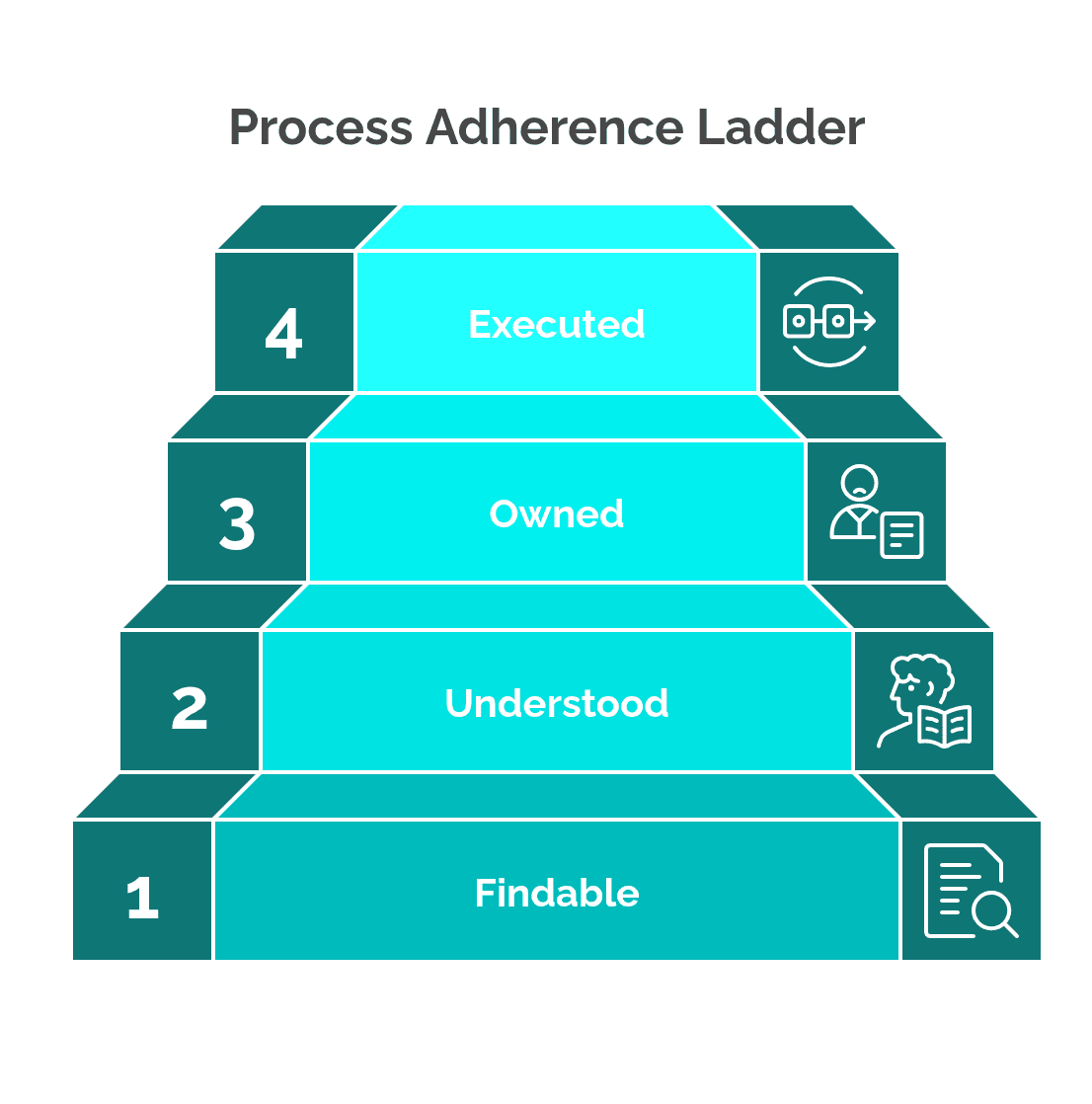
The Process Adherence Ladder is a four-step framework for diagnosing why a documented process is not followed. Each step is a condition for the next. A process must be findable before it can be understood. It must be understood before an owner can hold people to it. And it must be owned before it can be executed reliably.
| Step | Question | Anchor data (HEFLO Process Maturity Assessment) | Main lever |
|---|---|---|---|
| 1. Findable | Can people find the process when they need it? | 15.2% say "everyone" knows where documentation is (n=46) | Central process portal, search, single source of truth |
| 2. Understood | Do people understand the process, and were they trained? | 38.5% cite "not trained" as a reason to deviate (n=52) | Readable BPMN diagrams, onboarding through the process |
| 3. Owned | Is someone accountable for adherence? | 28.1% have ownership "clearly defined and enforced" (n=64) | Named process owner, change approval, versioning |
| 4. Executed | Does the process run in daily work? | 14.8% say processes are connected to workflow/automation (n=54) | Workflow, forms, business rules, SLA |
Example: a purchase request climbing the Ladder
| Step | Before (documentation only) | After (execution-connected) |
|---|---|---|
| 1. Findable | The procedure sits in a shared folder that only the finance team knows about | The approved process is published in a central process portal |
| 2. Understood | New analysts learn the rules from colleagues | A BPMN diagram shows the "amount above threshold?" decision and both paths, and onboarding uses the diagram |
| 3. Owned | Nobody approves changes, and old versions keep circulating | The procurement manager owns the process and approves each new version |
| 4. Executed | Quotes and approvals are tracked by email | A workflow requires the quotes above the threshold, routes the task to the approver and tracks the approval deadline |
Use the Process Adherence Ladder as a diagnostic. Find the lowest step where the process fails, fix that step first, then move up. Investing in step 4 (automation) while step 3 (ownership) is missing tends to automate a process that nobody governs.
Who should own process adherence?
A named process owner, with authority over changes and accountability for results. Among 64 respondents of the HEFLO Process Maturity Assessment, only 28.1% say process ownership is "clearly defined and enforced."
Ownership on paper is more common than ownership in practice. Among the same respondents, 34.4% say owners exist "but roles are unclear."
A process owner responsible for process adherence should:
- Approve every change before a new version is published.
- Keep one authoritative version of the process available to everyone who performs it.
- Review deviations, exceptions and feedback from the people who run the process.
- Decide when a recurring workaround should become the new standard.
- Be accountable for process KPIs, not only for the document.
This is governance and traceability: knowing who changed the process, when, why, and which version people were expected to follow.
Process adherence needs an owner with the authority to change the process and the accountability to make it stick.
How do you move a process from documentation to execution?
Model and automate the process in five steps.
- Model the process in BPMN 2.0. Represent tasks, roles, decisions and exceptions in a standard notation that business and IT teams both read. Keep the diagram readable, and split large processes into subprocesses.
- Publish the process in a central portal. Publish one approved version, accessible to everyone who performs the process, with documentation attached to each task.
- Connect tasks to forms and workflow. Turn the most frequent steps into assigned tasks with forms. The workflow then routes work to the right person and captures the right data.
- Define business rules and SLAs. Encode approval thresholds, routing conditions and deadlines, with alerts or escalations when a deadline is at risk.
- Measure and improve. Use execution data to find deviations and bottlenecks, then publish a new version through the owner's approval.
Start with one high-volume process where deviations have a visible cost, such as a purchase request, an employee onboarding or an internal service request. You do not need to automate the whole process landscape at once. In the purchase request example, the approval is a good first step: once it runs as a workflow task with a deadline, delays and skipped quotes become visible.
Documentation-only vs execution-connected processes: what changes?
| Criterion | Documentation-only process | Execution-connected process |
|---|---|---|
| Where the process lives | File, wiki, PDF | BPMN model + workflow in production |
| How employees learn it | Colleagues, trial and error | The workflow guides each task |
| What ensures adherence | Individual discipline | Rules, approvals and assigned tasks |
| Updates | Manual, often out of date | Published version = executed version |
| Visibility of deviations | Almost none | Exceptions and delays are visible |
| Measurement | Surveys, audits | Execution data (time, volume, SLA) |
Documentation remains essential. It supports compliance and certification audits, gives new hires a view of the end-to-end process, and covers judgment-based work that should not be automated. The goal is not to replace documentation with workflow. The goal is to connect them, so that the documented process and the executed process are the same.
A documentation-only process depends on discipline; an execution-connected process makes adherence the default.
Which BPM software features improve process adherence?
Choose BPM software by the adherence gaps it closes, not by the length of its feature list. The criteria below map to the steps of the Process Adherence Ladder.
| Ladder step | Feature to look for | Why the feature improves process adherence |
|---|---|---|
| Findable | Central process portal | One place to find the approved process |
| Understood | Documentation generated from the BPMN model | Documentation stays aligned with the diagram |
| Understood | Feedback on published processes | Users flag unclear or impractical steps |
| Owned | Native versioning with owner approval before publication | One authoritative version; change history kept |
| Executed | Workflow automation with custom forms | Tasks, data and routing follow the model |
| Executed | Deadline and SLA management with alerts | Delays become visible before they become failures |
These advanced features matter most when they share one model. If the portal, the documentation and the workflow live in different tools, the gap between the documented process and the executed process returns.
Example: HEFLO. HEFLO is a BPM platform that connects these criteria in one process model. HEFLO supports:
- BPMN 2.0 process modeling
- Process documentation generated automatically from the diagram, with PDF export
- A process portal where users consult published processes and send feedback through comments
- Native version control: a published process cannot be edited, changes go into a new version, and only one version is published at a time
- Process owner approval before publication, with an option to notify users when a process is published
- Workflow automation of BPMN processes, with custom forms
- Process and task deadlines with triggers, supporting SLA management
- AI assistance to generate and improve process documentation
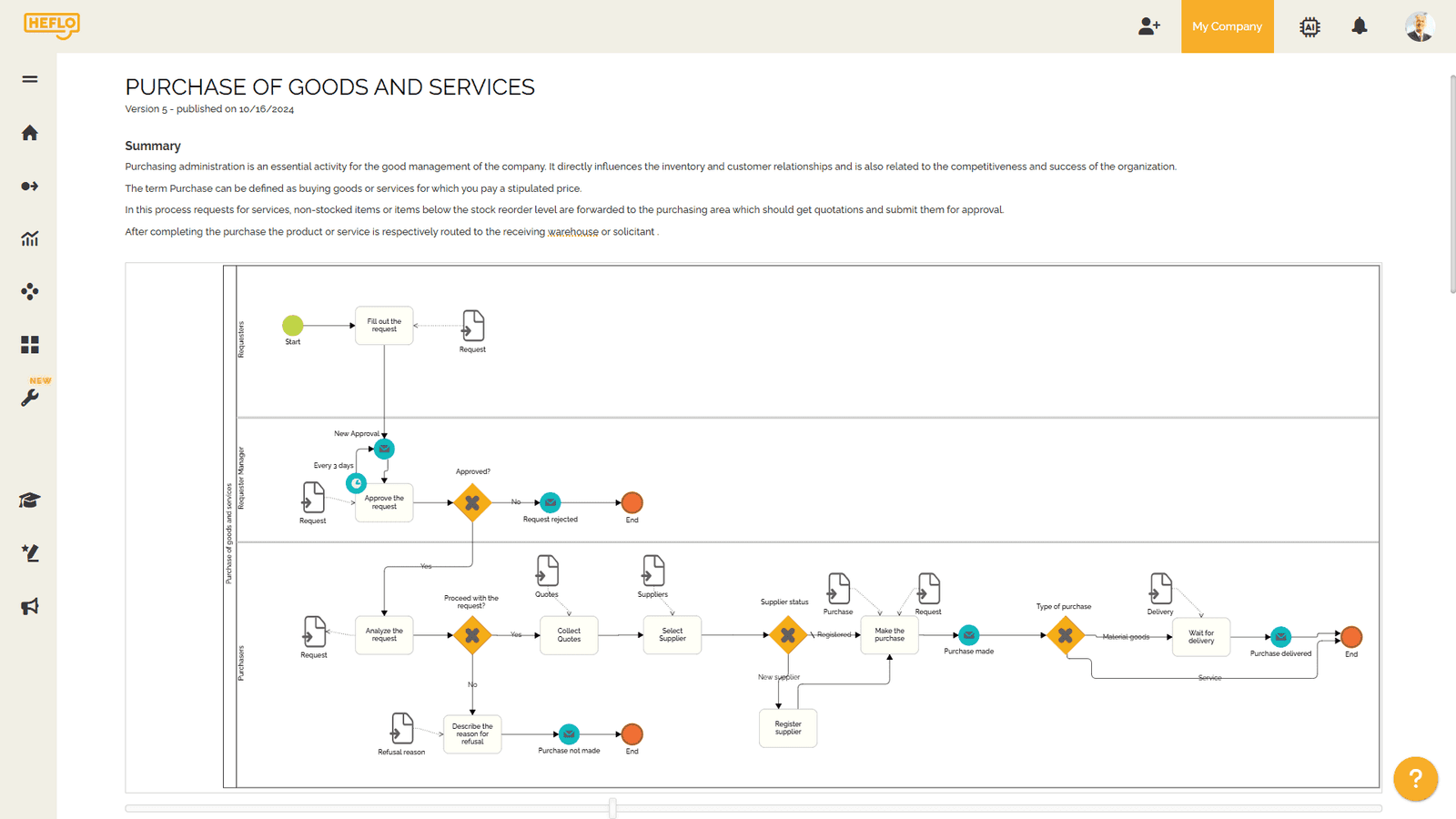
When you compare BPM software, the practical test is simple. Ask each vendor to take the same process, such as your purchase request, from diagram to portal to running workflow, and then to a new version, without leaving the platform.
How do you measure process adherence?
Measure behavior, not opinions. Self-assessment surveys show perception, while execution data shows practice. Track these KPIs for each critical process:
| KPI | What the KPI shows | How to read it |
|---|---|---|
| Share of cases executed in the workflow | How much work follows the official path | Cases handled outside the system are invisible deviations |
| Exceptions and deviations per period | Where the standard breaks | Recurring exceptions signal a design problem, not only a discipline problem |
| Rework rate | The cost of not following the standard | Cases returned for correction or missing data |
| Cycle time and its variance | Consistency of execution | High variance between performers suggests different practiced processes |
| SLA compliance | Respect of deadlines | Share of tasks completed within the defined deadline |
| Process documentation consultations | Whether people use the portal | Low consultation plus high deviation points to step 1 or 2 of the Ladder |
Review these KPIs with the process owner on a fixed cadence, and link every new process version to the KPI it is meant to improve.
What gets executed in a workflow can be measured; what lives only in a document can only be audited.
Checklist: is your organization ready to close the adherence gap?
Answer yes or no for one critical process:
- Is there one approved, current version of the process?
- Can everyone who performs the process find it in under a minute?
- Is the process modeled in a readable diagram, such as BPMN 2.0?
- Were the people who perform the process trained on the current version?
- Is there a named process owner who approves changes?
- Are previous versions and the change history kept?
- Can employees report unclear or impractical steps through a formal channel?
- Do the most frequent steps run as assigned tasks with forms in a workflow?
- Are deadlines or SLAs defined, with alerts before they are missed?
- Do you measure deviations, rework or cycle time from execution data?
Each "no" points to a step of the Process Adherence Ladder:
| Questions | Ladder step |
|---|---|
| 1 and 2 | Findable |
| 3, 4 and 7 | Understood |
| 5 and 6 | Owned |
| 8, 9 and 10 | Executed |
Fix the lowest step first.
Readiness to close the adherence gap is decided at the lowest failing step of the Ladder.
How was this data collected?
Methodology: HEFLO Process Maturity Assessment
- Source: HEFLO Process Maturity Assessment, a free online self-assessment published by HEFLO.
- Period: 83 unique sessions between April 2, 2026 and October 28, 2026.
- Sample per question: each question has its own number of respondents (n=42 to n=64); the n is reported with each figure.
- Languages: answers from the English, Portuguese, Spanish and French versions are combined.
- Respondents: anonymous and self-selected. Results describe respondents, not all organizations or any specific country.
- Multiple choice: where respondents could choose up to three answers, percentages do not add up to 100% and should not be summed.
The data is directional: it shows where respondents see gaps, not how widespread those gaps are across the market.
From documented to followed
Adding detail to documentation is the most common response to non-adherence, and the survey data suggests it is not the most effective one. Among respondents of the HEFLO Process Maturity Assessment, the leading reasons for deviation are missing enforcement and missing training, and few processes are connected to execution. The fix is structural. Make the process findable and understood, give it an owner, and run it as a workflow. A purchase request that runs as a workflow does not depend on anyone remembering the rule.
Benchmark your organization: take the free Process Maturity Assessment
See where your organization stands on each step of the Process Adherence Ladder. The Process Maturity Assessment is free, requires no signup, and compares your answers with similar organizations.
Want to see a documented process run as a workflow? Start a free HEFLO trial or request a demo.
FAQ: process adherence
Why don't employees follow documented processes?
Employees don't follow documented processes mainly because nothing in daily work enforces or teaches the documented way. Among 52 respondents of the HEFLO Process Maturity Assessment, the most cited reason for deviation is lack of enforcement (42.3%), ahead of lack of training (38.5%). Outdated or hard-to-find documentation is cited less often.
What is process adherence?
Process adherence is the degree to which the way work is actually performed matches the documented process. Process adherence differs from process compliance, which usually refers to meeting external regulatory or certification requirements. High process adherence means the documented, practiced and executed versions of a process are the same.
How do you improve process adherence?
Improve process adherence by climbing the Process Adherence Ladder. Make the process findable in a central portal, and make it understood through readable BPMN diagrams and training. Assign an owner who approves changes, and execute the process through workflow with forms, rules and SLAs. Fix the lowest failing step first.
Does process documentation guarantee compliance?
No. Process documentation proves that a standard exists, not that it is followed. Among 50 respondents of the HEFLO Process Maturity Assessment, only 14.0% say documented processes are always followed. Compliance requires evidence of execution, such as workflow records, approvals and change history, in addition to the document.
What is the difference between process documentation and process execution?
Process documentation describes how work should be done: steps, roles, rules and supporting information. Process execution is the work as it is actually performed. When a process is execution-connected, a workflow assigns tasks, collects data through forms and applies rules, so the documented process and the executed process are the same.
How can BPM software help employees follow processes?
BPM software helps employees follow processes by publishing one approved version in a central portal and keeping documentation aligned with the BPMN model. It also controls versions and changes, and runs the process as a workflow. The workflow guides each task, so employees follow the process without having to look it up.
Who should be responsible for process adherence?
A named process owner should be responsible for process adherence, supported by the managers who run the process daily. Among 64 respondents of the HEFLO Process Maturity Assessment, only 28.1% say process ownership is clearly defined and enforced. The process owner should approve changes, review deviations and be accountable for process KPIs.
What advanced features should a BPM tool have to enforce processes?
The advanced features that enforce processes are the ones that connect documentation to execution. They include a central process portal, documentation generated from the BPMN model, native versioning with owner approval, workflow automation with custom forms, business rules, and deadline and SLA management with alerts. Process automation matters most when it runs on the same model as the documentation.
Is HEFLO a good BPM software to document and execute processes?
HEFLO fits organizations that want to document and execute processes in one platform. HEFLO supports BPMN 2.0 modeling, documentation generated from the diagram with PDF export, and a process portal with feedback. It also offers native versioning with owner approval, workflow automation with custom forms, deadline management for SLAs, and AI assistance for documentation. Evaluate HEFLO against the Process Adherence Ladder criteria.
Which BPM software should a company choose to make processes stick?
A company should choose BPM software in which the published process and the executed process share one model. Test whether the BPM software can model in BPMN 2.0, publish to a portal, control versions, run the process as a workflow with forms and SLAs, and measure deviations. Run the same process end to end in each shortlisted tool.